Perfectionism is not a quest for the best. It is a pursuit of the worst in ourselves, the part that tells us that nothing we do will ever be good enough – that we should try again.
~Julia Cameron
I remember my first daughter’s baptism when our minister gave a sermon about how the lovely idea of babies, all downy hair and sweetness, is far from the reality; the truth is, she argued, is that ‘babies are messy, inconvenient, and exhausting’ but that we love them with all of our heart! She made this point in relation to how God loves us despite our humanness below the images we like to project.
We are all flawed and broken, but you may never know by the way we try to present ourselves to the world.
How often do you look at social media and (even though you know better!) get swept into thinking that everyone else is living the perfect life? It’s natural to think that, just as it’s natural to want to showcase the highlights of our lives on social media….the prettiest picture, the happiest dinner, or the sweetest moment. I think we all know that social media isn’t reality and that real life is messy,
My daughter and I just joined a research study on perfectionism in young adults and their parents. It has been an opportunity to reflect on my own perfectionist tendencies. Do I set unrealistic goals? well, yes! Do I give myself compassion when I don’t reach them? absolutely not! While I will never see my daughter’s responses, I worry that my own traits may be reflected in her responses too.
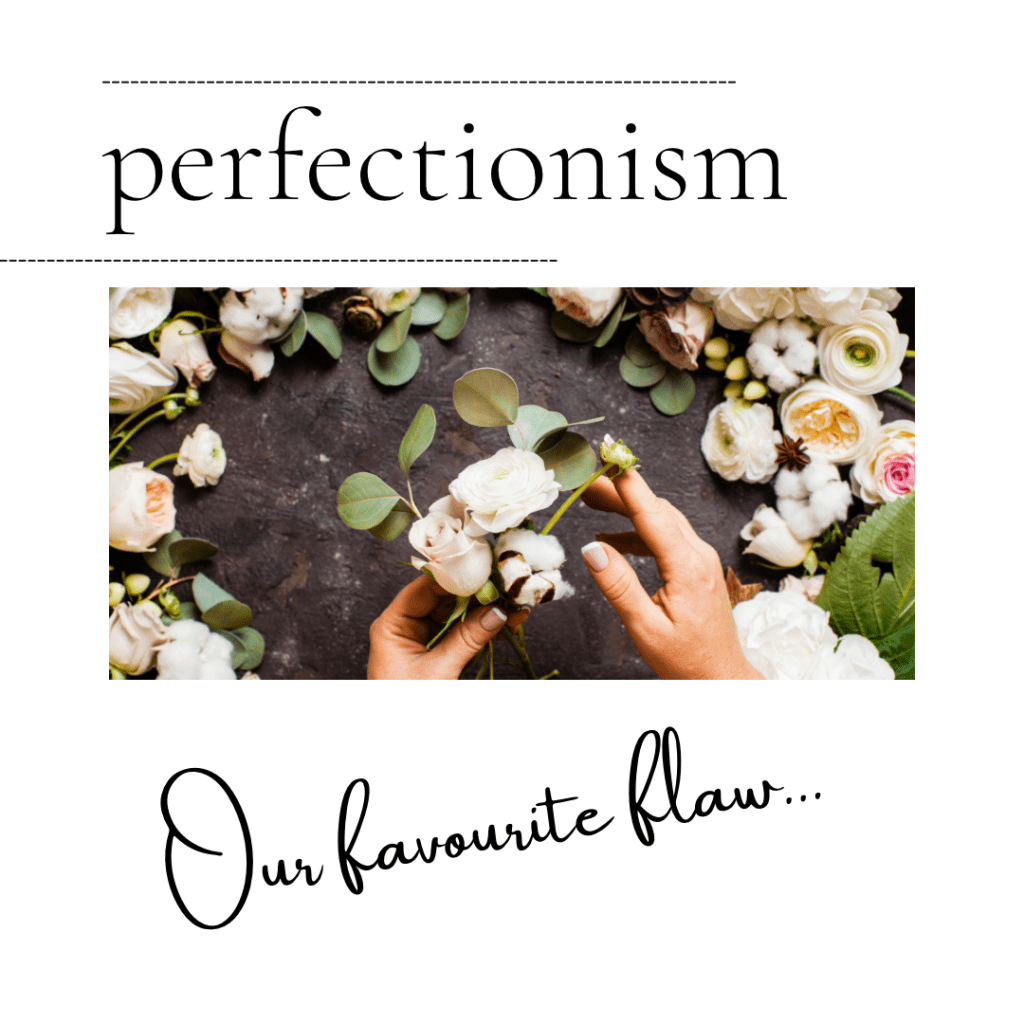
Whether it’s beauty, parenting, work, or relationships, there’s a drive to be successful at everything. Thomas Curran, author of The Perfection Trap documents the rise of perfection nd describes it as “our favourite flaw”, the quality that we feel isn’t really so bad because it motivates us. Research has shown, however, that this isn’t true: perfectionism creates a ton of emotional stress and can end up hindering our performance. In one study, self-described perfectionists put in LESS effort on the second round of an experiment when told they had failed the first, than those who went easier on themselves.
Curran describes the loneliness and isolation of perfectionism, and the cost for very little gain: “The deeper we fall into our culture’s perfection trap, the more perfectionism will drain the life from our lives.” (19)
I’m almost certain that if you are reading this, you can relate to some perfectionist qualities. You may not have them all, but our culture does tend to push us to be constantly striving and hustling. I don’t seem to suffer the procrastination and constant redoing that go along with perfectionism, but I do set completely unrealistic goals for myself and feel terrible if I miss the mark. I’m also very self-conscious about the ‘me’ that I put out to the world.
So what can we do? How can we ease up on ourselves?
Curran’s arguments are for deeper societal changes such as the way we measure success, collectively. He does have some practical solutions for individuals such as accepting “good enough” and striving towards goals while still being realistic and self-compassionate.
In addition, I explored some resources (listed below) for some more ideas to ease perfectionism:
- reframe what it means to be successful
- don’t take everything so personally (that’s my husband’s advice!)
- ask if your perfectionism is helping or hurting you
- set realistic goals
- accept the beauty and authenticity of imperfection
As I reflect on these ideas I think of ways to incorporate into my own life. As an example, reframing my efforts to plan events as still successful, even if the attendance doesn’t hit the number I’ve set in my mind. Or feeling comfortable posting pictures of myself and my life, even if they aren’t exactly the way I like.
How about you? Are you suffering from perfectionism? What would you take away and change?
As always, would love to hear your thoughts, privately or in the comments!

References
Curran Thomas. The Perfection Trap : Embracing the Power of Good Enough. First Scribner hardcover ed. Scribner 2023.
“How to Overcome Perfectionism, According to Experts.” Good Housekeeping, 10 May 2023, https://www.goodhousekeeping.com/health/wellness/a43643905/stop-being-a-perfectionist/.
How to Overcome Perfectionism | Psychology Today Canada. https://www.psychologytoday.com/ca/blog/anxiety-files/202104/how-overcome-perfectionism. Accessed 25 Sept. 2023.


 Barre with Justine
Leave a reply to kindlyaligned Cancel reply