
If you know me, you know how much I adore roses. I love rose essential oil, rose perfume, rose water as a toner, and even bake with rose water and rose petals! There is another part of the rose that I also put to use in skin care, and that is rosehip oil.
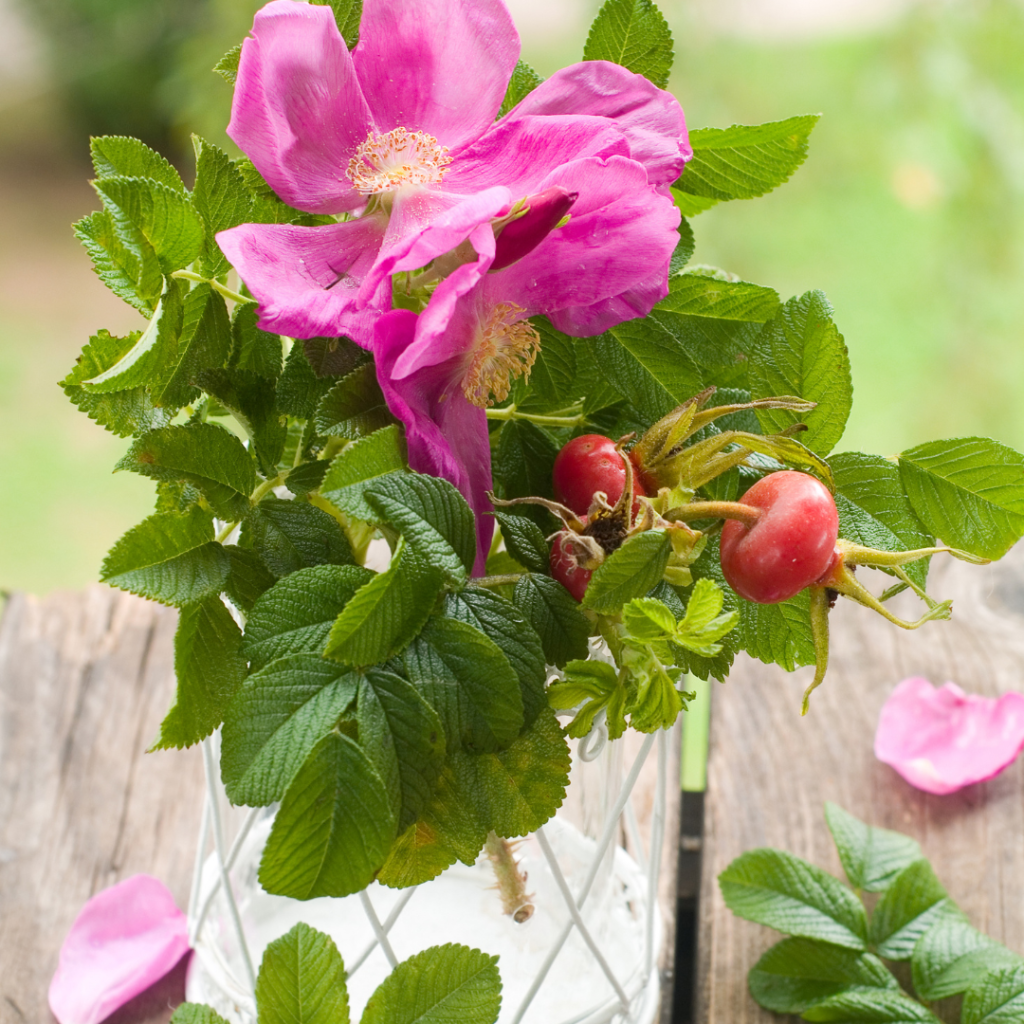
What exactly are rosehips and how do they relate to roses?
Rosehips are the bright red fruits that emerge on roses in mid to late autumn after the last petals have fallen from the flowers. Rosehips are rich in Vitamin C and bioflavanoids and have been used to make syrups and teas for many years. In Britain during World War II, rosehips were important for nutrition and children were given a dose of rosehip syrup every day for Vitamin C.
Rosehips are still included in from Davids Teas’ Serenity Now (a blend of strawberry, hibiscus & rosehips) to the reasonably priced single note tea from Herbaria. Personally, I had always wondered how much Vitamin C actually remained in the tea after making it, but this study reassures me that keeping the temperature relatively low and brewing for 6-8 minutes keeps the antioxidants in rosehip tea!
How is rosehip oil made?
Learning more about the production of rosehip oil has been fascinating to me. While many rosehip oil producers use the cold-pressing method to extract the oil, companies like Pai Skin Care and Kosmea use the CO2 extraction method and use the entire fruit (pulp, skin, and seeds). This method, according to the companies and some research, ensures a higher content of antioxidants in the final product (even cold-pressing oils involves some heat). Other producers may use just the seeds and a cold-press method to obtain the oil. Some rosehip oil used in cosmetics is also deodorized and refined.
You may find two different varieties of rosehip oil when you shop:
- Rosa Rubiginosa
- Rosa Canina
Rosa Rubiginosa (also known as Rosa Eglanteria and Rosa Mosqueta) is from a wild rose that grows in the Andes. Rosa Canina, according to incidecoder.com (a super-helpful cosmetic ingredient database!), is “the oil coming from the seeds of dog-rose, a wild rose species native to Europe, northwest Africa and western Asia.”
The oils are very similar but Rosa Rubiginosa may be considered slightly better quality, based on its composition.
How do rosehips relate to beauty?
Rosehip oil has been used for many years in beauty preparations for its moisturizing and healing properties. Rosehip oil is typically a reddish/orange colour and is considered a “dry oil”, which means that it absorbs into the skin quickly with no greasy feel. Rosehip oil is high in fatty acids and Vitamins E & A.
In terms of research, there isn’t an abundance of research but there are some studies that support rosehip oil’s traditional use for wound healing and anti-aging.
- a 2024 review in The Journal of Cosmetic Dermatology looked closely at 4 (of 20 total) articles to assess the potential for rosehip oil for wound healing concluding that “RO appears to have a plausible potential mechanism of action for improving scars, appears to be safe, and has been shown to improve scars in two clinical trials”
- a 2023 study of rosehip oil for hair growth was published in Preventative Nutritional Food Science and found that rosehip oil enhanced hair growth in rats. (I know…but maybe some benefits for humans!)
- Websites and books will often also refer to two studies done in Chile in the 1980s, one that found rosehip oil slowed down aging, reduced wrinkles, and restored natural skin tone and colour. The other study in 1988 identified retinoic acid as a component in rosehip seed oil. I haven’t been able to find these exact studies, but have found reference to them in many places.
How I like to use rosehip oil on my skin and my favourite rosehip oils…
Rosehip oil can be pricey so it’s usually a last step for me and I like to use it on its own, usually over moisturizer in the evening. Rosehip can have a yellowish tint so it isn’t always a great oil to use in the morning under makeup. In terms of brands, I like to use the Pai rosehip oil – it’s one of the first clean beauty brands I ever tried years ago. I’m also pretty excited to try this rosehip oil from New Roots because it’s the Rosa Rubinosa and I’m interested to see how in compares with the rosa canina in Pai’s version.
I have quite sensitive and dry skin so rosehip oil works well for me, but of course it’s best to do a patch test first to see if your skin reacts!
Have you ever used rosehip oil on your skin? I would love to hear!

read more
Belkhelladi, Malachy, and Amina Bougrine. ‘Rosehip Extract and Wound Healing: A Review’. Journal of Cosmetic Dermatology, vol. 23, no. 1, 2024, pp. 62–67. Wiley Online Library, https://doi.org/10.1111/jocd.15971.
İlyasoğlu, Huri, and Tuba Eda Arpa. ‘Effect of Brewing Conditions on Antioxidant Properties of Rosehip Tea Beverage: Study by Response Surface Methodology’. Journal of Food Science and Technology, vol. 54, no. 11, Oct. 2017, pp. 3737–43. PubMed Central, https://doi.org/10.1007/s13197-017-2794-2.
Mármol, Inés, et al. ‘Therapeutic Applications of Rose Hips from Different Rosa Species’. International Journal of Molecular Sciences, vol. 18, no. 6, 2017, pp. 1137-. ocul-bu.primo.exlibrisgroup.com, https://doi.org/10.3390/ijms18061137.

 Barre with Justine
Leave a Reply