
Over the last few years, I’ve watched the church at the end of my parents’ street be demolished and replaced by stacked condominiums. We never attended the church, but it still felt heartbreaking since it played a big role in my childhood. Since 1962 it had been a place of worship and a community hub, for everything from a ballet school to Scouts. I attended the daycare at the Church and my older daughter was able to do her daycare there before they moved, anticipating the sale of the Church. I took my ballet lessons there for years and saw a bustling building where people gathered to play badminton, host events, and build community. When Mountainview Church closed its doors, it was a harsh reminder that another community gathering place was gone forever.
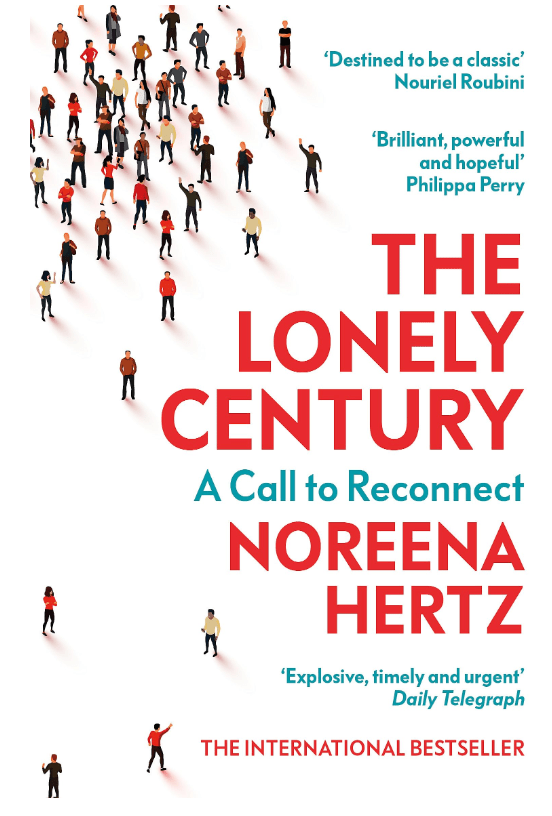
In The Lonely Century: How to Restore Human Connection in a World That’s Pulling Apart (2021), Noreena Hertz talks about how we are gradually losing the infrastructure of community, from community centres to libraries; the places where people with different backgrounds and experiences can gather together for a variety of purposes. Hertz argues that the lack of these spaces is becoming an issue because we no longer have that shared ground where we can mingle with others, easing not only loneliness but also exposing us to different backgrounds, views and perspectives. Perhaps politics might not be so vicious if we had these opportunities and spaces to listen and discuss ideas with others.
Following up on my last post about loneliness at work, I confess this is literally and emotionally a heavy read. The stories that Hertz uses to illustrate her points can be difficult to read (quite sad) and nearly a quarter of the book is the Notes section with references and explanations. Despite the melancholy that underpins the entire book, Hertz does offer some hope for this epidemic of loneliness in the last chapter.
In each chapter, Hertz explores the causes of our loneliness and how loneliness impacts our health. In the first chapter she notes that the trend towards less human contact was growing (often by choice), even before the pandemic: “…even when we do stuff ‘together,’ for increasing numbers of us this isn’t in the physical presence of another person: we ‘attend’ yoga class on an app, ‘speak’ to a customer service chatbox instead of a human salesperson, livestream a religious service.” (13)
Even the language has changed over the last decades where “collectivist words like belong, duty, share, and together have been increasingly supplanted by individualistic words and phrases such as achieve, own, personal and special.”(16). Loneliness seems to be one of the biggest societal challenges we are facing, but the news is not all bleak. Hertz points to the need for solutions that are bigger than just us (government policy, participation in democracy, local civics and community building) but emphasizes that we all have a role to play in our kindness and consideration towards others.
Key Takeaways for libraries
It’s impossible to condense all of the information Hertz shares in the book, but here are some of my key takeaways, as they related to libraries:
In-Person Matters
There is value in communicating in-person rather than over text or video. Beyond the misunderstandings or glitches that can make online communication challenging, Hertz notes that “when communicating in person, we don’t just mimic each other subconsciously, but electronic waves in parts of our brains actually synchronize.” (99). Providing opportunities for students to connect in-person through programming and spaces, libraries can encourage this kind of communication.
Loneliness has a big impact on student health & wellbeing
We often think of loneliness with being quiet and isolated, but the impact on the body is quite aggressive and agitates our nervous system. Loneliness is linked to higher levels of inflammation in the body, leading to lower immunity and higher stress. Hertz notes that “with loneliness, especially chronic loneliness, there’s no ‘off-switch’ to remind the body to calm down.” (27) Loneliness is also linked to suicide.
Knowing that university age students are reporting very high levels of loneliness (even pre-pandemic), it’s important for all university units to consider loneliness as a factor impacting health on campus. Being mindful of the loneliness that students may be feeling can go a long way in how we treat students and how we design programming and spaces.
Social Media and Loneliness – how libraries might help students cope
So much has been written about social media and its impact on mental health but it’s worth mentioning that a recent study in which university students reduced their social media time to 30 minutes a day improved their anxiety, fear of missing out, depression and feelings of loneliness. (Faulhaber & Gentile)
At the WILU conference in May, I attended a great presentation from University of Toronto librarians Julia Martyniuk and Carey Toane: “Data Detox Week: Building Capacity and Challenging Students to Take Control of their Digital Lives.” The session focused on the programming aimed to help students take control of their digital privacy and their time spent online, but I think it was really eye-opening for everyone in the session! I felt that this was such an important type of library programming to offer to university and college students who, while aware of the time drain and issues of online life, may struggle with how to cope. (*this is on my to-do list for this year or next!)
One of the sweetest surprises from my book clubs has been how often the students wanted to meet me in person, even when the meetings were held online.
Loneliness isn’t easy to solve on our own, but we can take steps to make connections and build interactions with others every day. One of the sweetest surprises from my book clubs has been how often the students wanted to meet me in person, even when the meetings were held online. There is something comforting in the thought that today’s students, despite their comfort with the digital, still enjoy meeting in person and getting to know new people. It is something that has really kept the book club at the top of my priority list!
Resources
Faulhaber, M. E., Lee, J. E., & Gentile, D. A. (2023). The Effect of Self-Monitoring Limited Social Media Use on Psychological Well-Being. Technology, Mind, and Behavior, 4(2: Summer 2023). https://doi.org/10.1037/tmb0000111
 Barre with Justine
Leave a Reply