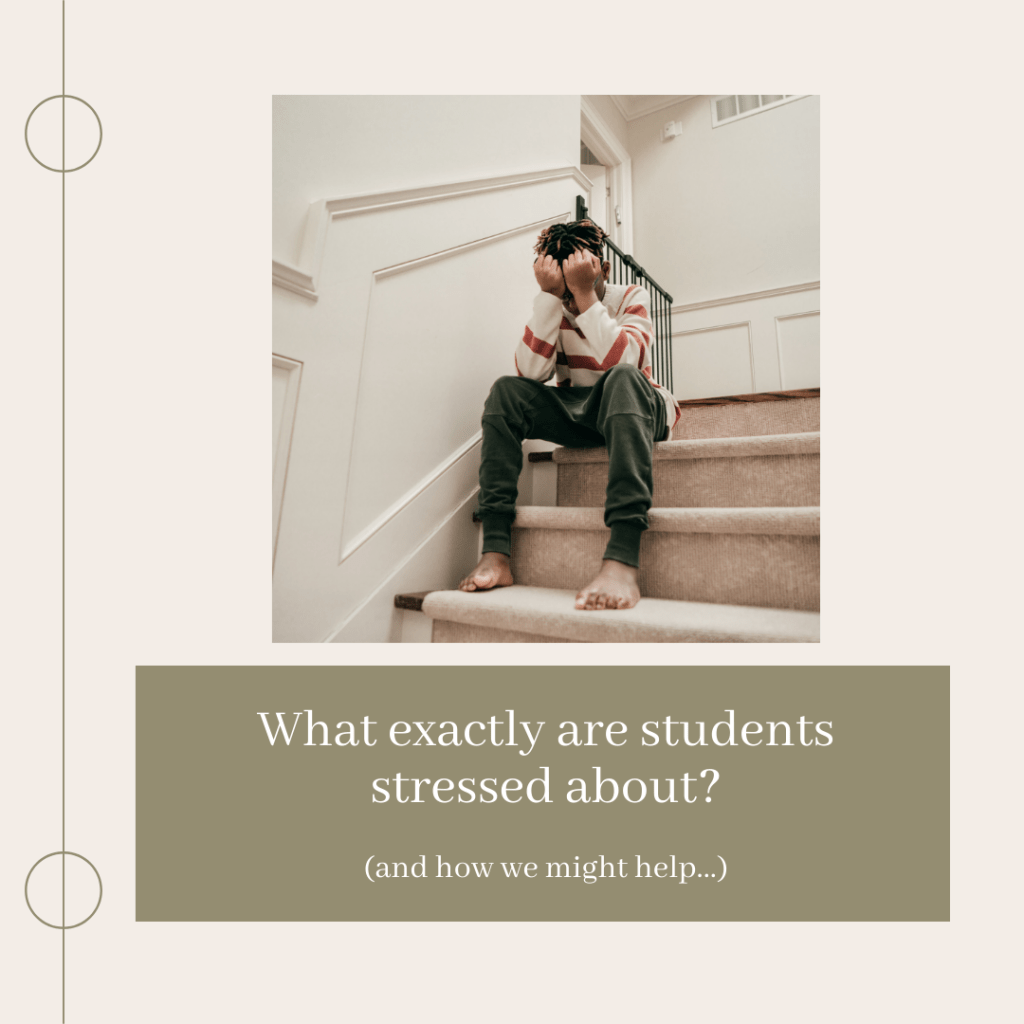
We use the word stress quite regularly in conversation. We might be stressed about the day ahead, stressed about our work or our health, stressed about finances. As casually and as often as we use the word, it can be hard to pin down the exact cause or severity of the stress. We know that stress is an issue on campus, with 7 in 10 students experiencing mental health issues including stress, anxiety and/or depression. We know the harmful effects of stress, such as poor sleep and high blood pressure. And stress can be dangerous for both our health and our wellbeing.
A recent survey (2023) done in the United States provides a window into what American college students are most worried about, in order:
- their own mental health
- personal finances
- academics
- mass shootings
- inflation/rising prices
It’s a fascinating glimpse into issues that may not have been top of mind for students even a few years ago. When I was in university, I worried a little about money, never about shootings, more about anxiety and academics. I do think the pressures on students are more intense these days and heightened by the stress of the pandemic and the generally gloomy state of the world some days.
In a *very* informal survey of my niece and her friends (all in second year university), they mentioned being stressed about school and the workload of classes. As I observe her and her friends, I’m reminded that they are dealing with many more layers of stress than I ever had to deal with in university: social media, more expensive EVERYTHING, and just different ways of socializing post-pandemic.
How can the library help with these stressors?
Stress can be difficult to measure and it can be easy to assume that everyone else in your situation is coping well. Students may feel they are the only ones worried about looming deadlines or finances. It’s very hard to compare my own stress as a mom of three with the experiences of an undergraduate – this is why encouraging students to join clubs and encouraging community-building events in the library can be so powerful. Knowing that other students are experiencing some of the same feelings can be incredibly comforting.
Academic libraries have always supported students academically by teaching information literacy skills and helping students one-on-one with research questions. Students may not always take advantage of the academic supports offered by the campus library, but it is one way to ease some of the stress on students who may be doing research for the first time or who may be overwhelmed by the university library.
Financial stressors are more difficult to address but libraries traditionally have made resources available to patrons, from books to workshops. We can continue to offer programs and collections that open up new opportunities to students who may not be able to access them otherwise. Programs like yoga, materials like sporting equipment or board games, and access to streaming music & video collections can help students to de-stress without having to spend money.
Wellness, at its worst, can be an expensive and exclusive endeavour – this is not the type of wellness that is suited for most stressed out students.
It is somewhat heartbreaking to see mass shootings among the top five stressors for college and university students. My sense is that, if this were a survey of Canadian students, it may not be in the top five. In August, I participated in an online meeting of the ACRL Library Marketing and Outreach Group of Greater NYC (presenting my book club experiences). In the meeting, I was able to hear a moving presentation from Holly Flynn Outreach Librarian at Michigan State University Libraries called “Creating Community: The Library as a Safe Space After a Mass Trauma.” In the talk, Holly discussed the after effects of the February 2023 shootings on campus and how the library played a role as a place for students to gather and try to ease the stress and trauma of the event (therapy dogs were brought in nearly immediately after the school reopened). Holly’s presentation gave some insights into the challenges (media intrusion, coordination, communication) following a traumatic incident and the role the campus library could play in supporting students. You can watch Holly’s presentation (and the others from the meeting) here.
Resources:
“Mental Health, Recession and Mass Shootings among College Students’ Top Concerns in 2023.” TimelyCare, timelycare.com/college-students-top-concerns-2023/?cat=news. Accessed 13 Sept. 2023.
Sweet, Jacob. “The Loneliness Pandemic.” The Loneliness Pandemic | Harvard Magazine, harvardmagazine.com/2020/12/feature-the-loneliness-pandemic. Accessed 13 Sept. 2023.
 Barre with Justine
Leave a Reply