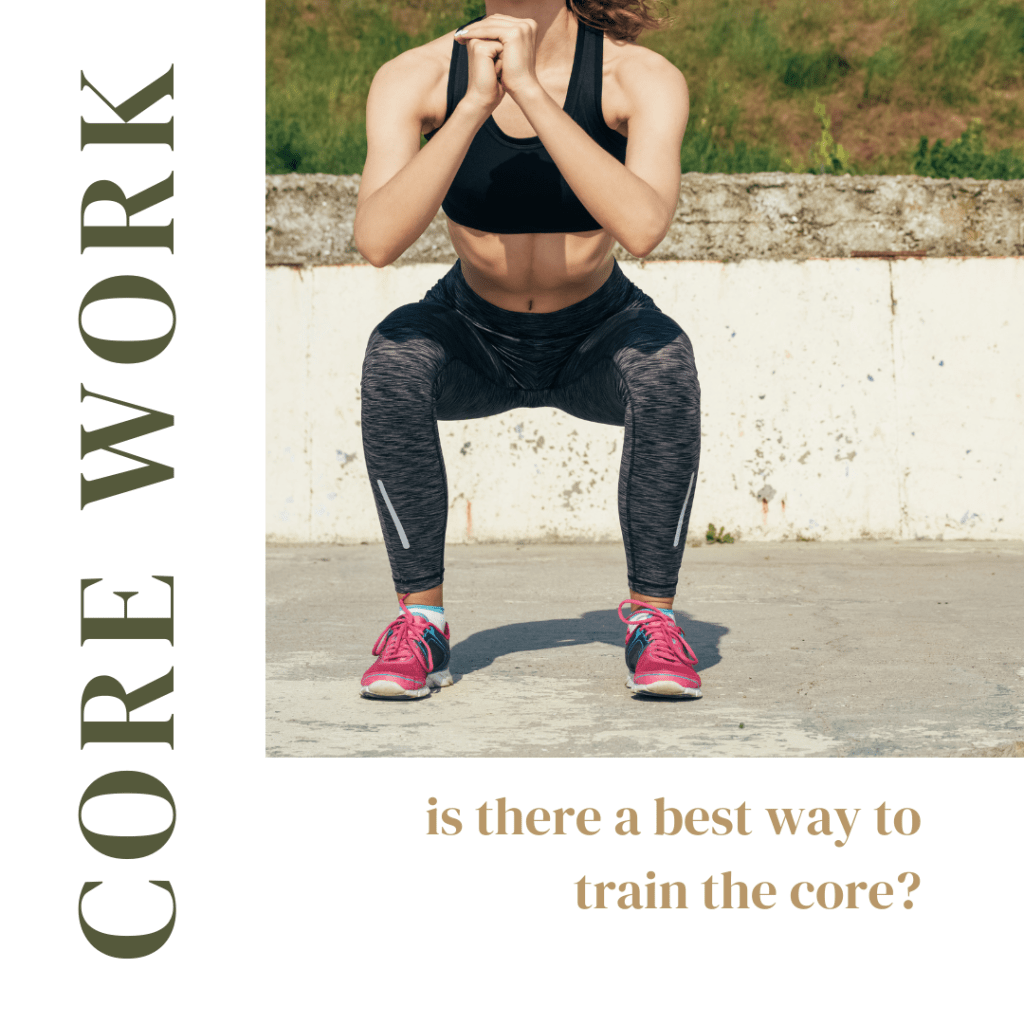
We probably all know the importance of having strong core muscles (beyond the desire to have a lovely waistline!). Strong core muscles help to protect the spine, the hips, and keep us moving throughout our life. With limited time and a confusing array of options, how do we decide the best way to incorporate core training into our routines?
In 2001, the American Council of Exercise (ACE) sponsored a study to determine the most effective “ab exercises,” determining that the Captain’s Chair, Bicycle crunch, and crunches on a swiss ball were the best choices. (*these studies are typically done by measuring the muscle activation during the movements.) Of course, this was over 22 years ago when we still talked about “ab work” and swiss ball workouts (and even fitness classes) were extremely common. Exercise trends change and evolve, and in more recent years we speak of “core training” and incorporate moves that challenge the entire body in a functional way and tools like breathwork, relying less on more traditional “ab moves” like crunches. This study is still talked about a great deal and I think there’s still a lot of value in the moves that were selected.
More recently, a 2020 systematic review broke the core muscles into six groups (rectus abdominus, internal oblique, external oblique, erector spinae, lumbar multifidus, and transversus abdominus) to determine the best moves for activating the muscles. The authors also separated the exercises into four groups: traditional core exercises, stability exercises, core exercises on a ball/device, and free-weight exercises.
| 2020 systematic review of core exercises | some of the best moves |
| rectus abdominus | – free weight, unilateral Bulgarian squat (lunge) – core exercises on the ball (e.g. roll out plank) |
| internal oblique | – front plank with scapular adduction |
| external oblique | – free weight Bulgarian squat – “stir the pot” on the swiss ball |
| erector spinae | – free weight exercises (deadlifts, back squats, hip thrusts) |
| lumbar mutifidus | – front plank on swiss ball |
| transverse abdominus | – suspension training systems – bird-dog (!) |
tell me more about the muscles in the core!
If you are curious to know more about the various muscles that comprise the abdominals, this is a handy little (open-access!) diagram (cited below) :

In class, I like to describe the core muscles as wrapping our entire mid-section, with the transverse abdominus being the deepest layer and the one that we engage in moves like plank and push-ups. The obliques help us twist and stretch to the side and the rectus abdominus is the visible muscles you can see in the “six-pack”.
The glutes (the biggest muscles in the body) are also considered to be part of the core and they are very important for stabilizing the hips and powering us in exercises like walking, running, and moves like squats and lunges. One little muscle that isn’t pictured in the diagram above is the quadratus lumborum (QL) muscle, which helps with lateral flexion. If you’ve ever done a class with me you will know that there’s a favourite stretch I do to target this muscle…love it! The QL is the deepest back muscle – hard to stretch – and it can cause a lot of stiffness in the lower back if it tightens up.
what are the takeaways?
- don’t stress about doing specific CORE exercises in your workout…as long as you are doing multi-muscle movements like squats, push-ups, lunges, etc. you will be working your core muscles!
- experiment with unilateral movements to activate the core even more during strength training – e.g. a single leg deadlift with one dumbbell.
- pay attention to your nutrition and hydration – it’s very true that even the best workout can’t make up for poor nutrition. For me, increasing protein and vegetables is the best way to build muscle and avoid more naughty foods.
- sleep! many studies have found a connection between poor sleep and abdominal circumference.
- think ahead! core strength isn’t only about how you look, but also how you feel and how well you will age. We want to protect the spine and hips, giving us the strength to keep walking, getting up off the floor and moving with confidence throughout our entire life!
References
Kim, Dongho. “Muscle 2: Axial Muscles of the Abdominal Wall and Thorax”. OER Commons. Institute for the Study of Knowledge Management in Education, 28 Nov. 2016. Web. 25 Jun. 2023. <https://oercommons.org/authoring/18530-muscle-2-axial-muscles-of-the-abdominal-wall-and-t>.
Oliva-Lozano JM, Muyor JM. Core Muscle Activity During Physical Fitness Exercises: A Systematic Review. Int J Environ Res Public Health. 2020 Jun 16;17(12):4306. *open-access
 Barre with Justine
Leave a Reply