
I love reading books about human behaviour and relationships; how the words we choose impact how we are perceived, the various ways that body language affects our interactions with others, and – most importantly – applying these ideas to my experiences in the classroom (or fitness studio!)
It’s refreshing to take relevant ideas from these books and reflect on how they might inspire the teaching that I do in the library classroom or the fitness studio. While the books and the discussions rarely deal specifically with teaching, there are many elements that translate beautifully into the experience of learning and the relationships that are built in the classroom.
Over the past few months, these are a few of the books that have had an impact on how I approach teaching:
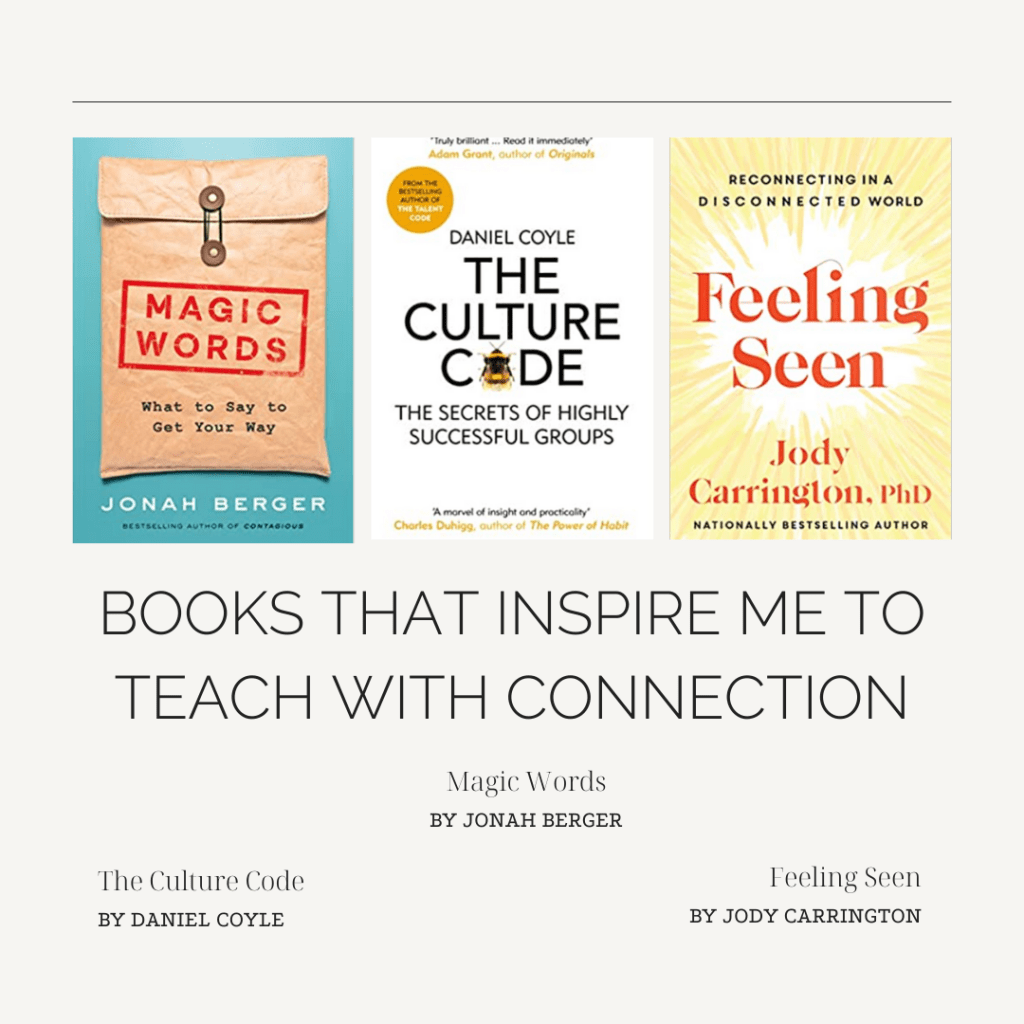
Magic Words by Jonah Berger
Magic Words is based on Berger’s communication research (he is a Marketing Professor at the Wharton School at U. Pennsylvania) and is a fascinating look at how word choice can impact the likelihood of getting what we want from a conversation. For instance, saying that you “recommend” rather than “like” something makes people 32% more likely to follow your suggestion.
Librarian: “I recommend creating a list of keywords to search in the database.”
VS
Librarian: “I like creating a list of keywords when searching in a database.”
Berger writes that “everyone wants to see themselves positively” and that using an identity or noun when communicating is more powerful for changing behaviour, than using a verb. For instance, preschool children who were asked to be a “helper” were more likely to help tidy up than if they were simply asked “to help”. According to Berger, “now picking up blocks isn’t just helping, it’s an opportunity. An opportunity to claim a desired identity.”
In the library classroom, we might refer to students as scholars, turning an action into an identity to change their behaviour and increase their desire to learn the skills of research. In a fitness environment, class participants could be part of the team or the squad (and you will often hear this in fitness classes!).
Berger has also found that speaking with certainty ensures that listeners won’t tune out what we are saying. This means avoiding words like may, could, think and replacing them with words like “definitely, clearly, obviously”. This particular recommendation can be thorny when it comes to library teaching or really any teaching in an academic setting.
As a librarian, I can be apprehensive about speaking with too much certainty about a subject. Can you relate? In academia, we are teaching students about the nuance in different topics, the various approaches to research and understanding…it had made me reflect on the library classroom however. Is it a place to dissect the intricacies of information or the opportunity to teach students, with certainty how to practically search for and vet information?
The Culture Code by Daniel Coyle
note: I reviewed this book on my personal blog, so the following is from that review.
The Culture Code: The Secrets of Highly Successful Groups outlines the practical skills that create groups that can do amazing things and that people WANT to be part of. The book opens with an interesting experiment where various groups attempted to build the tallest tower from materials like marshmallows, spaghetti and masking tape. In almost every version of the experiment, groups of kindergarten children beat out lawyers, CEOs and business students. They worked efficiently, experimented, and did not compete against one another within the group. Coyle uses this example to launch into what he believes are the important skills that create successful groups:
- building a safe environment where people feel they belong
- sharing vulnerability at every level of the group
- establishing a shared purpose
The examples in the book are fascinating, from a exploration of how the legendary Christmas Day truce during WWI was built over weeks of “shared belonging cues” (Chapter 3) to how the CEO of Zappos designed the home office building to maximize “collisionable hours” where staff could bump into one another and connect. I had to share the Chapter about San Antonio Spurs Coach Gregg Popovich with my husband because he loves inspirational sports stories. In the Chapter, Coyle describes how Popovich creates a sense of community within players through the cues that essentially say – ‘you are part of this group’, ‘this group is special, we have high standards here’ and ‘I believe you can reach those standards.’
I had so many observations that apply to both fitness and library work (I’m still reflecting on many of these!):
- feeling safe – it surprised me just how important feeling safe is in terms of people feeling like they belong AND how constant reminders of safety are required. According to Coyle, successful groups have “profuse” eye contact, physical touch (handshakes, hugs), intensive listening, and humour. As Coyle writes: “Spending time inside these groups was almost physically addictive.” (8). In terms of fitness, this made me reflect on how to make all participants feel they belong, whether through touch or listening…I think we all do this instinctively but, again, maybe not as OFTEN as constantly!
- belonging – Coyle writes that belonging needs to be reinforced over and over again…”a flame that needs to be continually fed by signals of safe connection.” (26). He uses the example of how Google defeated AdWords in the early days of online advertising, likely because of the environment at Google where every employee felt they could tackle a problem, even if it was not a part of their role in the company. This skill resonated with me when it comes to library teaching…an approach where learning research skills is a shared endeavour where we tackle a problem as a team.
- vulnerability – leaders who don’t cover their weaknesses, admit failure, seek help, and dive into the trenches (e.g. like the All Black rugby team leaders who do the menial work (“sweeping the sheds”) to foster the ethic of teamwork. After this section, I thought about how difficult it is to show our weaknesses in academia – there’s a sense that we should know everything about research or be the “experts”. This has changed a bit for the better over the last few years but it’s still hard to show vulnerability – at least for me.
- shared purpose – Coyle writes that successful groups have a shared purpose that is clear (“be 10x as clear about your priorities as you think you should be”), visible (as a reminder), and that measuring success should relate to the purpose (what really matters). In group fitness, I could imagine this being applied when we tell participants why we do an exercise or a type of class, being clear about expectations, and having a personal mission statement or teaching philosophy.
The Culture Code has practical applications that anyone can use to connect better with others in a classroom setting.
Feeling Seen by Jody Carrington
Carrington is a Canadian psychologist who has written a beautiful book about the power of connection. “I spend a lot of time thinking about how much I wish people knew just how much they mattered to each other,” she writes poignantly, “About how many times just a smile, or a kind gesture, not only changed a life, but saved it.” (4)
This book dives into the many reasons why we are so disconnected at this point (the pandemic is of course a part of this very recent book) and how we can rekindle connections with each other. The importance of acknowledging the emotions we carry and helping others ‘feel the feelings’ is discussed, as well as suggestions for building empathy.
My favourite takeaway from this book is what Carrington calls “the light up” or when your face lights up when you see another human. She gives the example of a military member returning from oversees, and that intense moment of emotion when they see their loved ones. The “light up” is what happens when someone you love so deeply shows up and your expression overflows with emotion.
I found a lovely video of Toni Morrison talking with Oprah about this very topic, in the context of her children. It’s a sweet video and a great reminder of just how powerful our reactions to other people can be!
The energy we bring to a classroom is contagious. If we enter with a positive and open vibe, students are more likely to be engaged than if we come into a classroom without making eye contact or with low energy. This is likely the most parallel experience to teaching a group fitness class. Even if you are feeling tired, you need to summon the energy to lift others up and motivate participants to move. Big gestures, smiles, eye contact and nodding to participants has, in my experience, always lifted the class energy and led to more engaging classes.
Its rewarding to find books that can provide new ideas for creating classroom engagement. Research on social behaviour, as outlined in the books mentioned above, can feel a bit “corporate” but it is a way to gain deeper insights into what creates deeper connections in the classroom and among colleagues. I’m always looking for ways to refine my skills in classroom teaching and these books have given me many practical ways to create better connections – I hope they will for you too!

 Barre with Justine
Leave a Reply