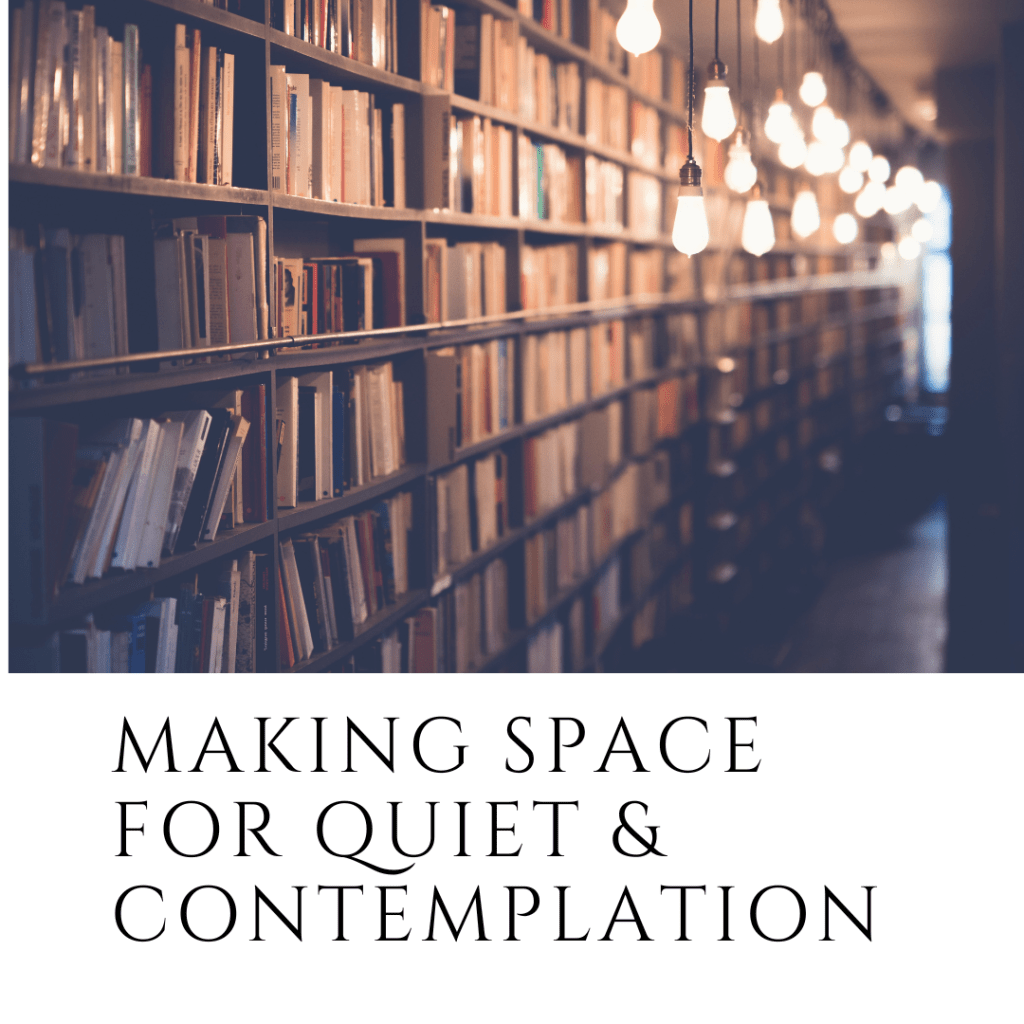
I have very fond memories of the Library at Bishop’s University, where I did my undergraduate degree. At that time, the silent study carrels had windows that overlooked the woods around campus and I spent many evenings looking out at the snow softly falling in the darkness, thinking and reflecting as I worked on essays for my English Literature and History classes. Residence was noisy but this was a place just a few feet away that offered space and silence to find meaning in the poems of Thomas Hardy or to read first-hand accounts of soldiers during the Great War. There was also the beautiful “Old Library” on campus, which held the Archives and where I did a great deal of research about poets of the First World War.
While most academic libraries still preserve space for silent study, collaborative study spaces and Learning Commons have featured prominently in new library design and renovations. Silent space is almost like the dusty, neglected attic space of university libraries – figuratively and literally! Students certainly need space for group work and collaboration, but they also continue to articulate the need for quiet space, in surveys and anecdotally in conversations that I’ve had.
In Stemmer & Strawser’s 2019 article “Silence in a Noisy World”, based on a survey about space, they conclude that: “Students still appreciate the opportunity and ability to study alone and to separate themselves from distraction…collaborative space is necessary, but remember to offer students a place for silence in this noisy world.
When I’ve chatted with students informally about their campus experiences, I often hear the same thing – they struggle to find quiet spaces on campus and usually end up high into our library tower, seeking out the silent spaces.
Interview with Laurie Morrison about Quiet Spaces
My colleague, Laurie Morrison, Collections Librarian at Brock, is also on a sabbatical this year and her research in part looks at how quiet and silent library spaces facilitate deep learning and concentration. I was happy to ask her about quiet spaces in academic libraries – why they are important, what these study spaces should look like, and the mission of the university library in offering this type of environment.
What are your thoughts on the benefits we get from quiet spaces?
There is a good deal of evidence from many disciplines on the benefits of quiet. It has been observed that the brain needs quiet. It is necessary for more executive cognitive functions. Studies have shown that cognitive functions such as reading, memory and problem solving are strongly affected by noise. In the absence of noise, researchers have found that the brain remains active and dynamic. In fact, what is described as the default mode of the brain when it is resting quietly, that it is engaged in self-reflection and is integrating external and internal information that it has received. In other words, a quiet surrounding provide our cognitive grey cells a much needed respite where we develop a deeper understanding of ourselves and where we fit in the world.
How do we balance the need for quiet, contemplative spaces with the need for students (or anyone) to connect and collaborate?
There is a good deal of evidence from many disciplines on the benefits of quiet. It has been observed that the brain needs quiet. It is necessary for more executive cognitive functions. Studies have shown that cognitive functions such as reading, memory and problem solving are strongly affected by noise. In the absence of noise, researchers have found that the brain remains active and dynamic. This quiet resting state of the brain is described as the default mode of the brain. It is in this mode that our grey matter is engaged in self-reflection and is integrating external and internal information that it has received. In other words, a quiet surrounding provides our cognitive grey cells a much needed respite where we develop a deeper understanding of ourselves and where we fit in the world.
What would your ideal quiet space include?
It needs to be as inviting as any other space in our libraries. It is not enough to just put rows of study carrels in a space and call it quiet study. This is functional but is not designed with the user in mind.
This is a short list of features to create a quiet space:
- book stacks (there still are some) can be used to help break up space and make it more visually interesting.
- architectural design features for walls and ceilings that can enhance quiet.
- windows that look out on the campus and provide natural light.
- use neutral colours which are known to affect a calming mood which has been proven to improve focus.
- use of both large tables and study carrels to offer students a choice in their workspace.
Overall, the space should inspire and create a sense of community among students who are engaged in deep thinking and contemplation in their scholarly pursuit.
Are libraries unique in the space they offer?
We are in a world that is increasingly noisy, so much so that quiet has become a commodity. Consider for example the popularity of noise cancelling headphones (a decent pair is in the range of $400) as evidence of a world that is increasingly loud. In this sense, our libraries can offer a service that is difficult to find. On our campuses, I think it is definitely unique though for campuses with a chapel or similar, students can find quiet (though these are not intended as study spaces). If I do a mental scan of campuses I am familiar with, it is not hard to identify many informal gathering places where students can find space to work individually with ambient noise (if that is a preference) or in groups such as dining areas and cafes. However, the same cannot be said for quiet areas void of sound distractions. In this sense, the quiet study locations in libraries provide this unique refuge.
Final Thoughts
I appreciate that Laurie was able to put into words the way I think many librarians feel about quiet space and academic libraries. There is value in preserving these spaces and also in making these spaces beautiful and inviting. Even if these spaces are hidden in the stacks or on higher floors in the library, the benefits that they provide to students are important enough to make a strong case to invest in these pockets of quiet in this “noisy world”!
References
Stemmer, John, and Michael G. Strawser. “Silence in a Noisy World: Using Student Feedback to Enhance Library Silent Study Space.” Evidence Based Library and Information Practice, vol. 14, no. 3, 2019, pp. 128–34. *open access*
 Barre with Justine
Leave a Reply